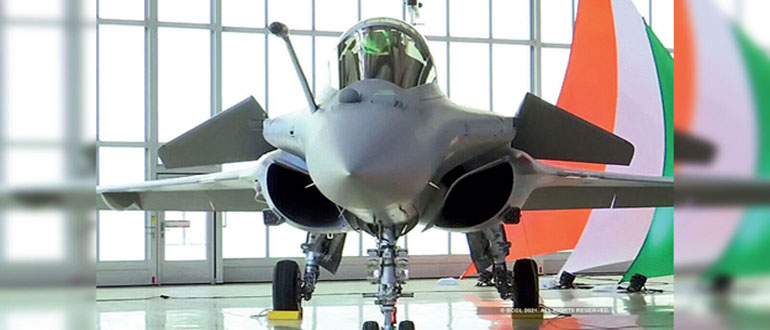
Srinagar | WTNS | Feb 20,2026: India is moving toward a major expansion of its naval aviation capability with plans to order 31 additional Rafale M carrier-based fighter jets, on top of the 26 aircraft already contracted for the Navy, according to La Tribune.
Agha Syed Amin | Wilayat Times
Srinagar | WTNS | Feb 20,2026: India is moving toward a major expansion of its naval aviation capability with plans to order 31 additional Rafale M carrier-based fighter jets, on top of the 26 aircraft already contracted for the Navy, according to La Tribune.
If the deal is concluded, India’s total Rafale fleet will rise to 145 aircraft, marking a significant strategic milestone for both New Delhi and Dassault Aviation and reinforcing France’s position as one of India’s most trusted defence partners.
The additional Rafale M fighters are intended for deployment aboard Indian aircraft carriers, where they will form the backbone of the Indian Navy’s carrier air wings. Designed for catapult-assisted take-off and arrested recovery, the Rafale M provides the Navy with a versatile multirole platform capable of fleet air defence, long-range maritime strike, and precision attack missions, including the use of advanced weapons such as the AASM Hammer in complex operational environments.
India’s growing Rafale inventory is the result of a steady deepening of defence ties with France. In September 2016, New Delhi and Paris signed an intergovernmental agreement for the supply of 36 Rafale fighters valued at €7.87 billion, a contract that has since been fully executed, enabling the Indian Air Force to raise two fully operational squadrons. This was followed in 2025 by an order for 26 Rafale M jets for naval aviation, and the proposed acquisition of 31 more aircraft now signals a clear political and strategic choice by India in favour of continuity, proven performance, and operational autonomy.
Beyond combat capability, the Rafale program has become a cornerstone of defence industrial cooperation between the two countries. France, together with India’s defence industry, is implementing a localisation strategy aimed at expanding manufacturing and technological expertise within India.
A central role in this effort is being played by Reliance Defence through the joint venture Dassault Reliance Aerospace Limited (DRAL), with production facilities in Nagpur initially focusing on fuselage sections and airframe components.
At the same time, Hindustan Aeronautics Limited has been brought into the Rafale ecosystem to support maintenance, repair and overhaul activities, as well as the future integration of Indian-developed weapons systems.
In a notable transfer of capability, France has also granted India exclusive rights to manufacture selected Rafale components and precision-guided munitions. Indian enterprises are expected to begin producing the modular AASM Hammer air-to-surface bombs, a weapon system previously manufactured exclusively by Safran Electronics & Defense, significantly strengthening India’s indigenous precision-strike capacity.
The prospective order of 31 additional Rafale M jets underscores India’s intent to secure a robust and technologically advanced carrier aviation force while deepening a strategic defence partnership with France. At a time of increasing maritime competition and evolving security challenges, the expansion of the Rafale fleet highlights New Delhi’s determination to project power, protect its interests at sea, and enhance long-term strategic autonomy.