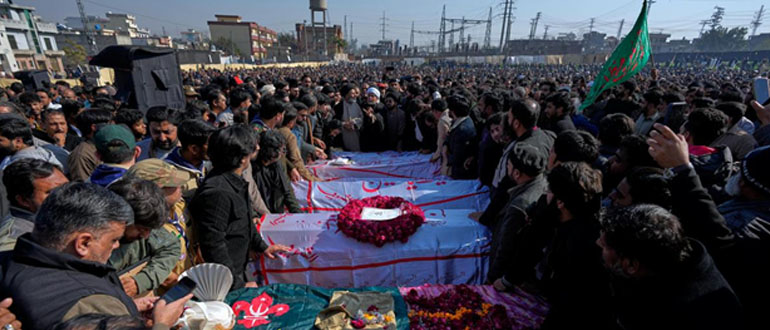
Islamabad | Feb 06, 2026: The explosion happened at the Khadija Tul Kubra / Imam Bargah mosque in the Tarlai Kalan area, when many worshippers were present for congregational prayers.
They came with clean hands and God’s name on their lips.
They came looking for mercy, not death.
They came to a house of prayer, not a place of killing.
Yet even the house of God was not spared.
During the quiet of Friday prayers, as foreheads touched the ground in surrender, a suicide blast ripped through the Khadija-tul-Kubra Mosque in Islamabad’s Tarlai Kalan.
In a moment, prayer turned into panic. Silence turned into smoke and screams. At least 31 lives were lost, and many more were left wounded some forever.
The mosque that once echoed with “Ameen” now echoed with cries.
Prayer mats were soaked in blood.
Walls built to witness faith were torn apart by hate.
Bodies lay where people had bowed before Allah.
This was not a battlefield.
This was not a place of power or politics.
This was a sanctuary.
Security guards tried to stop the attacker, but the blast came first. It did not see age or strength. Children, elders, and worshippers were all struck the same way , victims of a cruelty that has no faith and no God.
In hospitals across the city, grief had a face. Mothers searched for sons who did not answer. Fathers held clothes stained with blood. The injured were brought in on stretchers, in arms, even in the backs of cars some alive, some already gone.
One man spoke of his father, his voice filled with fear:
“He has a hole in his stomach.”
Words that will stay with him long after the wounds heal.
ISIL (ISIS) claimed responsibility, but no claim can explain how prayer becomes a crime, how a mosque turns into a grave, how God’s name is used to break every command of God.
Thousands of mourners gathered in the capital on Saturday to bury the victims of the attack, which killed at least 32 worshippers and injured 170 others, officials said.
Leaders condemned. Countries expressed sorrow. Statements were made.
But the mosque remains wounded.
This was not only an attack on Shias.
It was not only an act of terror.
It was an attack on the idea of holiness itself
On the belief that a place of worship is safe simply because people are praying.
When a mosque is violated, humanity hangs its head.
When worshippers are killed in sujood, history cries.
And from the rubble, one painful question rises:
If even the house of God is not safe, where can the faithful go?
Demonstrations broke out from Friday evening and continued through Saturday in Srinagar, Baramulla, Budgam, Bandipora, Anantnag, and Jammu.
In Baramulla’s Pattan and Bandipora’s Shadipora areas with a significant Shia population protesters openly raised anti-Pakistan slogans, reflecting growing anger over what many described as Pakistan’s entrenched pattern of sectarian violence. “At a time when Muslims across the world are under attack, Shia Muslims continue to be systematically targeted in Pakistan,” a protester in Pattan said, calling the killings “shameful and indefensible.”
Kashmir’s chief cleric, Mirwaiz Umar Farooq, condemned the bombing as a grim reminder of the vulnerability of places of worship to extremist violence. “Bloodshed in such a manner, that too at a place of worship, is profoundly distressing and unsettling, a moment of deep pain and reflection for the ummah,” he said.
Religious leaders in Jammu and Kashmir went further, directly questioning the Pakistani state’s responsibility. Aga Syed Hassan Al-Mousavi, president of the Anjuman-e-Sharie Shian J&K, termed the attack a “barbaric assault on the core tenets of Islam and humanity,” and demanded immediate, concrete action to protect Pakistan’s Shia population. “Condemnation without accountability is meaningless,” he said.
All Jammu and Kashmir Shia Association, led by cleric and Peoples Conference leader Molvi Imran Reza Ansari, said its protests were aimed at holding Pakistan accountable for what it called the “brutal blast at Imambargah Khadijat-ul-Kubra in Tarlai.”
Young Cleric Moulana Masroor Abbas Ansari also denounced the attack, warning that continued impunity for sectarian violence would only deepen regional alienation and mistrust.