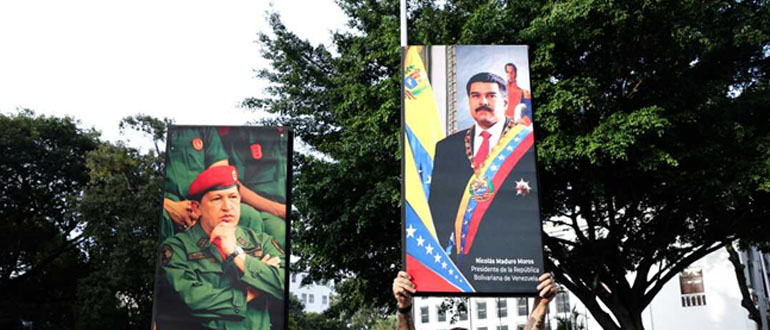
New Delhi | WTNS | Jan 3,2026: Caracas awoke to explosions and the roar of low-flying aircraft. In a shocking escalation, U.S. forces carried out a military strike against Venezuela, seizing its democratically-elected President Nicolás Maduro and his wife.
“From Caracas to the UN, the world reels as Trump claims victory, while nations warn of a dangerous new precedent.”
Waseem Reza | Wilayat Times
New Delhi: On January 3, 2026, Caracas awoke to explosions and the roar of low-flying aircraft. In a shocking escalation, U.S. forces carried out a military strike against Venezuela, seizing its democratically-elected President Nicolás Maduro and his wife.
The operation was conducted unilaterally, without a UN mandate, and accompanied by public statements from U.S. officials declaring control over Venezuela’s leadership and resources. For much of the world, this act represents not justice, but brazen lawlessness.
The Venezuelan vice president strongly slammed the kidnapping of the country’s President Nicolas Maduro by the US, stressing that Maduro is the only president of Venezuela.
Speaking to reporters on Sunday, Trump said he could authorize another incursion if the United States does not achieve its goals of opening Venezuela’s oil industry and curbing drug trafficking. He also issued threats of possible military action involving Colombia and Mexico, while suggesting Cuba’s communist government was weakening.
The Attack and Its Human Cost
Reports indicate that at least 40 people including civilians and military personnel were killed in the strikes. Venezuela declared a national emergency as its citizens fled the streets, witnessing their country’s sovereignty violently violated.
The U.S. openly stated its intention to “temporarily run Venezuela” and exploit its oil reserves, revealing that the operation was motivated as much by strategic and economic interests as by any claim of law enforcement.
Global Condemnation
The United States carried out large-scale military strikes on Venezuela and detained President Nicolas Maduro and his wife, triggering widespread international condemnation and renewed accusations of American imperial aggression.
Latin America:
Colombian President Gustavo Petro and leaders from Brazil, Mexico, Chile, and Uruguay condemned the U.S. operation as an illegal act of aggression, emphasizing the need for respect for human life, sovereignty, and international law.
Spain, Brazil, Chile, Colombia, Mexico and Uruguay issued a joint statement rejecting ‘the unilateral military operations in Venezuela’ and warn against exploiting its natural resources. The signatories say the operation to oust Maduro was conducted in violation of international law.
Middle East & Asia:
Iran denounced the operation as “state terrorism” and called for UN intervention, while China condemned the U.S. “hegemonic acts” threatening regional peace.
Russia & Africa:
Russia reaffirmed support for Venezuela, and the African Union warned that unilateral military actions undermine the global rules designed to protect sovereign nations.
Europe and Public Opinion:
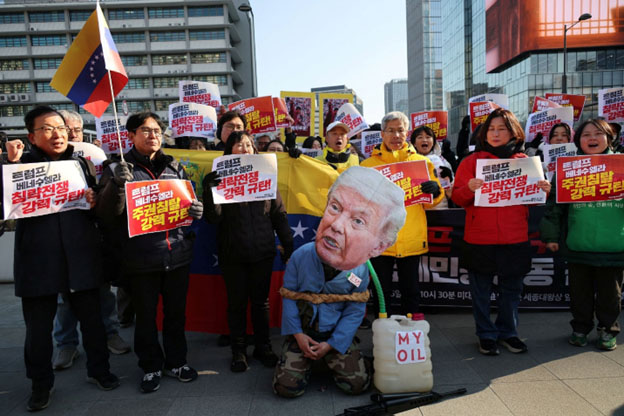
Protests erupted in Greece and other nations, with demonstrators decrying U.S. imperialism. Analysts note that even countries usually aligned with the West are increasingly uneasy with the erosion of international norms.
U.S. Allies:
Israel, Britain, and Ukraine welcomed the removal of Maduro, standing in stark contrast to widespread international condemnation.
Legal and Moral Implications
The operation flouts the UN Charter, which prohibits force against the territorial integrity or political independence of any nation. UN Secretary-General António Guterres called it a “dangerous precedent” with worrying implications for the region.
“The Secretary-General is deeply alarmed by the recent escalation in Venezuela, culminating with today’s United States military action in the country, which has potential worrying implications for the region,” said a statement issued by UN Spokesperson Stéphane Dujarric.
Independently of the situation in Venezuela, these developments constitute a dangerous precedent. The Secretary-General continues to emphasize the importance of full respect – by all – of international law, including the UN Charter,” the statement continued. “He’s deeply concerned that the rules of international law have not been respected.” Mr. Guterres called on all parties involved to engage in “inclusive dialogue” in accordance with human rights and international law.
Human rights experts emphasize that decades of abuses in Venezuela cannot justify the extrajudicial abduction of its leader. The UN Fact-Finding Mission on Venezuela stressed that civilian protection and accountability must remain priorities, not unilateral interventions by a foreign power.
Iranian Foreign Minister Abbas Araqchi described the U.S. strike as state terrorism, underscoring the violation of sovereignty and the Venezuelan people’s right to self-determination.
Seizing Venezuela’s Wealth
Today, Chevron is the only U.S. oil company still allowed to operate in Venezuela, producing roughly 220,000 barrels per day. A company spokesperson, reached on Saturday, declined to confirm whether any personnel or assets were affected by the U.S. raid, emphasizing only that the safety of staff and operations remained a priority. Chevron maintained that it continues to operate “in full compliance with all relevant laws and regulations,” quietly benefiting from a military intervention that reopened American access to Venezuelan oil.
Strategic Interests and Global Risks
Trump’s admission that U.S. oil companies would exploit Venezuela’s reserves highlights that economic gain is at the heart of the intervention. Analysts warn that the operation sets a dangerous precedent: if one state can forcibly remove leaders under pretext of law while seizing resources, no country is safe from foreign coercion.
This normalization of military coercion threatens global stability, undermining decades of international law and the principles that prevent unchecked use of force.
The World Faces a Choice
Venezuela has requested an emergency UN Security Council meeting to address the crisis. Maduro may face trial in U.S. courts, raising unprecedented legal questions about the extraterritorial seizure of a sovereign head of state.
The world now confronts a stark question: will international law be defended, or will the use of unilateral force become the new norm?