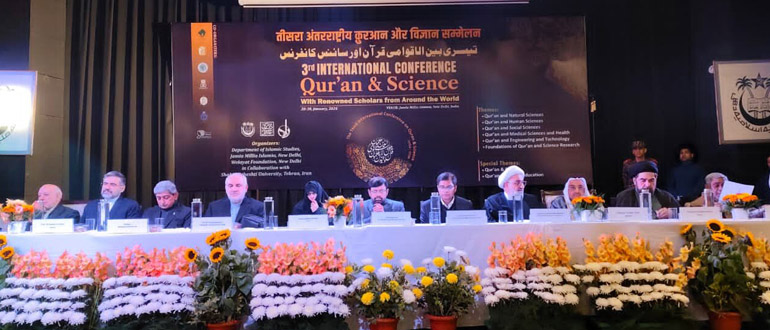
New Delhi | WTNS | Jan 30,2026: Is it possible for modern science to advance without losing its moral compass, and can sacred scripture guide inquiry without substituting for empirical method? These questions animated a three-day international conference on “The Qur’an and Science” held at Jamia Millia Islamia, one of India’s most prominent public universities.
Agha Syed Amin | Wilayat Times
New Delhi | WTNS | Jan 30,2026: Is it possible for modern science to advance without losing its moral compass, and can sacred scripture guide inquiry without substituting for empirical method? These questions animated a three-day international conference on “The Qur’an and Science” held at Jamia Millia Islamia, one of India’s most prominent public universities.
The conference, organized jointly by the university’s Department of Islamic Studies, the Wilayat Foundation, and Shahid Beheshti University of Tehran, brought together more than 35 scholars from India and abroad, representing countries including Iran, Iraq, Kuwait, Sudan, Indonesia, and the United Arab Emirates. Over the course of 13 academic sessions, participants presented more than 40 research papers, exploring the relationship between revelation, reason, and contemporary scientific challenges.
Rather than positioning the Qur’an as a repository of scientific facts, speakers repeatedly stressed its role as a source of ethical orientation. The emphasis, many said, should be on how religious texts shape purpose, responsibility, and the humane use of knowledge.
Presiding over the concluding session on January 30,2026, Hujjat-ul-Islam wal-Muslimeen Dr. Abdul Majeed Hakim Ilahi, the representative in India of Iran’s Supreme Leader, said that the Qur’an should not be read as a textbook of physics, chemistry, or biology. Instead, he argued, it provides a moral and intellectual framework that gives scientific inquiry direction and anchors it in concern for human welfare.
“The Qur’an offers principles that connect knowledge with ethics,” Dr. Ilahi said, adding that scientific progress divorced from moral responsibility risks losing its higher purpose. He described the conference as an effort to foster meaningful dialogue between religion and science and to cultivate creative thinking among younger scholars and future scientists.
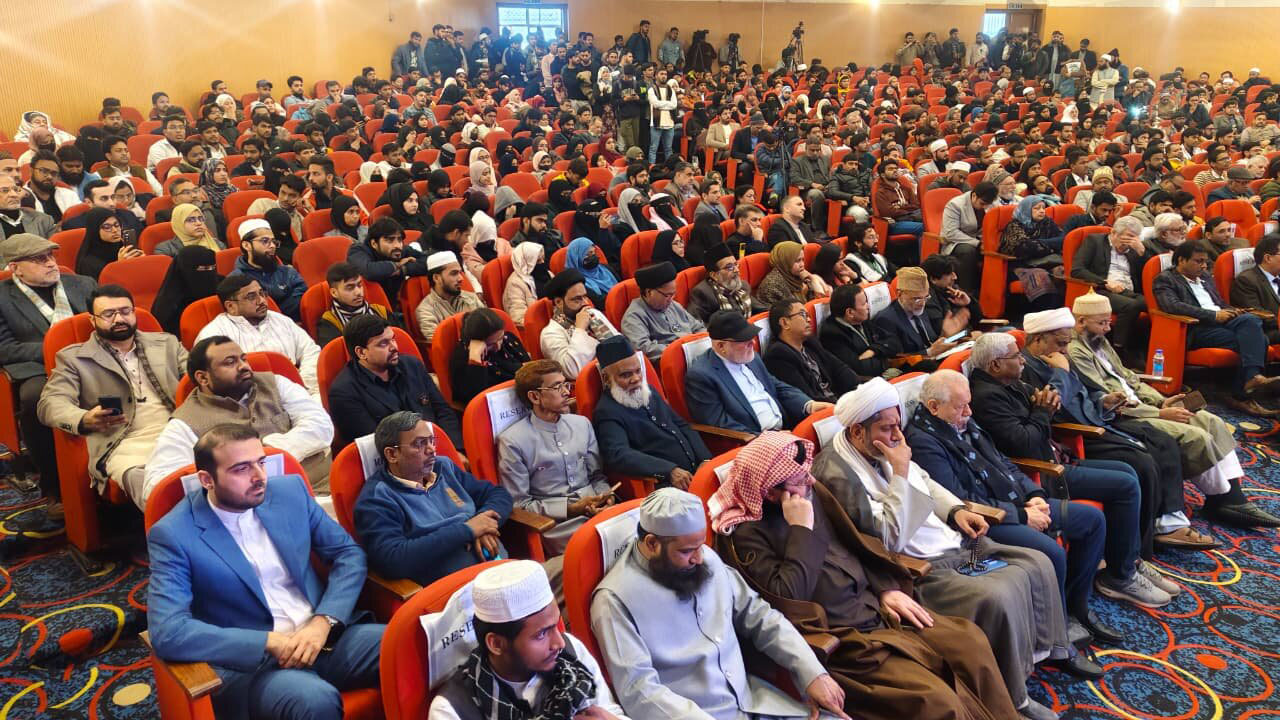
The Ambassador of the Islamic Republic of Iran to India, Dr. Mohammad Fattali, echoed that view, urging readers to engage deeply with the meanings and message of the Qur’an. Many verses, he noted, explicitly encourage observation, reflection, and contemplation , intellectual habits that lie at the heart of scientific inquiry.
For Professor Iqtidar Mohammad Khan, the conference director and dean of the Faculty of Humanities and Languages at Jamia Millia Islamia, the challenge lies in avoiding extremes. Rejecting science in the name of religion, he said, is as misguided as reshaping revelation to fit changing scientific theories. The more sustainable path, he argued, lies in balance, dialogue, and a harmony between faith and reason.
The conference also reflected broader concerns about unity and identity in the Muslim world. Dr. Rehana Sadat Raisi, daughter of Iran’s late president Syed Ebrahim Raisi, attended as a special guest and spoke about the enduring unity of the Muslim Ummah despite differences of language, ethnicity, and nationality. That unity, she said, rests on shared Qur’anic values rather than political boundaries.
Other participants focused on the civilizational implications of knowledge pursued without ethical grounding. Engineer Mustafa Abbas of Kuwait said the Qur’an consistently calls on humanity to remain engaged in reflection and observation so that the mysteries of the universe may be understood on firm intellectual foundations.
Professor Mohammad Mehdi Esmaili, a former Iranian minister and guest of honour, warned that a purely materialist understanding of life narrows the purpose of science and distances it from justice, spirituality, and collective responsibility. Similarly, Professor Dr. Mohammad Ismail Akbari of Shahid Beheshti University of Medical Sciences, Tehran, emphasized that understanding the Qur’an requires translating its message into lived practice rather than limiting it to theoretical appreciation.
Indian scholars added historical and textual perspectives to the discussion. Professor Musheer Hussain Siddiqui, former head of the Department of Arabic at Lucknow University, described reflection and critical thinking as central to the Qur’anic message. Professor Mohammad Faheem Akhtar Nadwi, former head of the Department of Islamic Studies at Maulana Azad National Urdu University, Hyderabad, cited Prophetic tradition to argue that returning to the Qur’an is essential in times of intellectual confusion and social upheaval.
Others cautioned against subordinating scientific inquiry to scripture. Syed Kalbe Jawad Naqvi said science should neither dominate religion nor be dominated by it; rather, it should be understood in the light of ethical guidance, a balance he described as essential for sound scholarship.
Sessions were moderated by a diverse panel of academics, including Dr. Khurshid Afaq, Dr. Mohammad Tahseen Zaman, Dr. Abrar-ul-Haq, Dr. Anees-ur-Rahman, Dr. Mohammad Usama, Dr. Mohammad Masihullah, Dr. Nadeem Sehar Anbareen, Dr. Mohammad Ali, Dr. Owais Manzoor Dar, and Ms. Maria Zahra.
The conference concluded with a call for intellectual renewal in Muslim societies through the integration of modern scientific methods with moral frameworks rooted in the Qur’anic worldview. Dr. Mohammad Hussain Ziaei Nia, associated with the Office of the Representative of the Wali-e-Faqih in India, said such integration is essential if scientific advancement is to serve humanity rather than alienate it.
As participants departed, there was broad agreement on one point: in a world shaped by rapid technological change, the conversation between science and ethics is no longer optional. The gathering at Jamia Millia Islamia sought not to close that debate, but to deepen it and to ensure that it remains guided by reflection, responsibility, and human dignity.