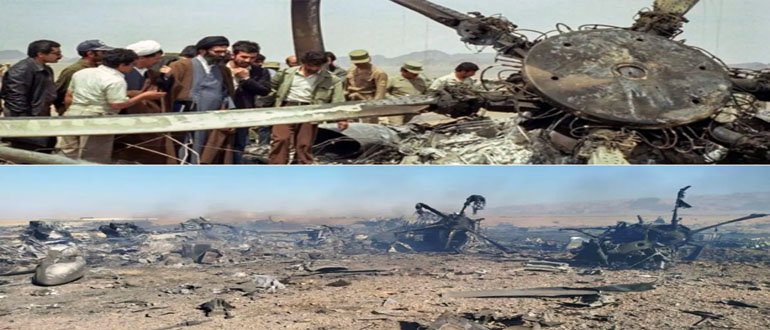
Tehran | March 11, 2026:In a stunning display of coordinated defensive warfare, Iranian forces – combining the Islamic Revolution Guards Corps (IRGC), police commando units, Basij resistance fighters, and regular army elements – destroyed two American C-130 transport planes and two Black Hawk helicopters in southern Isfahan province early on Sunday.
The complex operation transformed a US rescue mission into the most embarrassing American military debacle since the 1980 Tabas desert catastrophe.
The thirty-seventh day of the US-Israeli aggression against the Islamic Republic of Iran did not begin with American triumph as some US officials claimed, but with Iranian fire.
Just after dawn on Sunday, Washington launched what it would later desperately frame as a successful rescue operation for a downed F-15E pilot from the 3 April engagements. Instead, the mission became a complete operational collapse.
Within hours, the spokesperson for the Khatam al-Anbiya Central Headquarters announced that Iranian joint forces had destroyed two C-130 military transport aircraft and two Black Hawk helicopters in southern Isfahan province. Images of burning wreckage – geolocated and verified by Press TV – circulated across global platforms, drawing immediate and unavoidable comparisons to Operation Eagle Claw, the failed 1980 American rescue mission that ended with eight US soldiers dead and aircraft abandoned in the Tabas desert.
For the Islamic Republic, it was not merely a defensive feat. It was historical revenge, divine justice, and a military-technological declaration that US power holds no sway over Iranian skies.
DESPERATE RESCUE BORN FROM EARLIER DEFEAT
The events of Saturday cannot be understood in isolation. They were the direct consequence of the black day that had struck American air power on April 3, when Iranian integrated air defense networks downed an F-15E Strike Eagle over central Iran, along with an A-10 Thunderbolt II over the Persian Gulf, multiple MQ-9 Reaper drones, and cruise missiles.
The F-15E, a twin-seat multirole strike fighter valued at over $90 million, disintegrated upon impact in Kohgiluyeh and Boyer-Ahmad province. The crew member or members remained missing, despite an initial American extraction bid that cost the aggressors two Black Hawk helicopters damaged by Iranian ground fire on April 3. There is no evidence that US forces were able to locate the pilot.
By Saturday, US commanders faced an impossible choice: abandon a missing airman to Iranian custody, or launch a deeper, riskier incursion. They chose the latter. That decision would prove catastrophic.
MORNING OF 5 APRIL: JOINT FORCES SPRING THE TRAP
At approximately 09:20 local time on April 5, American aircraft began entering Iranian airspace. The formation included two C-130 Hercules transport planes alongside two UH-60 Black Hawk helicopters.
What the Americans did not anticipate was the full integration of Iranian defensive assets: IRGC Aerospace Force radar and missile batteries, police special operations commando units, Basij resistance fighters, and regular army air defence elements – all operating under a single command structure.
As the C-130s approached their landing zone, Iranian police commando units opened heavy fire, immobilizing the first transport aircraft. Minutes later, IRGC air defence systems locked onto the second C-130 and the two Black Hawks. One by one, the American aircraft were struck.
The first C-130 was completely destroyed. The second was struck during an attempted escape manoeuvre. Both Black Hawks were downed, their wreckage scattered across the arid landscape. At least five American personnel were killed.
The IRGC’s Public Relations Department issued a devastating statement: “The invading enemy aircraft are now burning in the flames of the wrath of the heroic fighters of Islam.”
TABAS PARALLEL: HISTORY REPEATS
Even before the smoke had cleared over Isfahan, Iranian officials drew an unmistakable historical parallel: the failed American Operation Eagle Claw of April 1980.
That aborted mission had sought to rescue US captives from Tehran but ended in disaster at Tabas. A sandstorm, equipment failures, and a catastrophic collision killed eight American servicemen.
On 5 April 2026, 46 years later, history repeated itself with even greater Iranian proficiency. Where Tabas failed due to weather, Isfahan was the product of deliberate, coordinated Iranian defensive action. Iranian forces did not wait for nature to defeat the Americans; they destroyed them directly.
Speaker of the Iranian Parliament Mohammad Baqer Qalibaf posted an image of the destroyed C-130 wreckage on X, writing: “If the United States gets three more victories like this, it will be utterly ruined.”
STRATEGIC IMPLICATIONS: THE DEATH OF CSAR DOCTRINE
The destruction of two C-130s and two Black Hawks carries profound strategic implications. Combat search and rescue (CSAR) has been a cornerstone of American air power doctrine since the Vietnam War. The Isfahan operation has demonstrated that Iranian defensive networks can systematically dismantle the very rescue architecture designed to recover downed pilots.
For American military planners, the lesson is devastating: no US aircraft can consider Iranian airspace survivable.
As the US-Israeli aggression continues, the Islamic Republic’s message to Washington is unmistakable: the skies over Iran belong to Iran, and any further intrusion will be met with the same fire that turned Isfahan into the second Tabas.
SIDEBAR ONE: $700M AWACS BITES THE DUST
On March 27, 2026, the IRGC Aerospace Force destroyed an E-3 Sentry AWACS aircraft ($700 million) at Prince Sultan Air Base in Saudi Arabia, along with two EC-130H Compass Call electronic warfare planes and multiple KC-135 tankers. The strike used ballistic missiles and drones, penetrating Patriot batteries. Cost imbalance: Iranian munitions (few hundred thousand dollars) vs. billions in US losses.